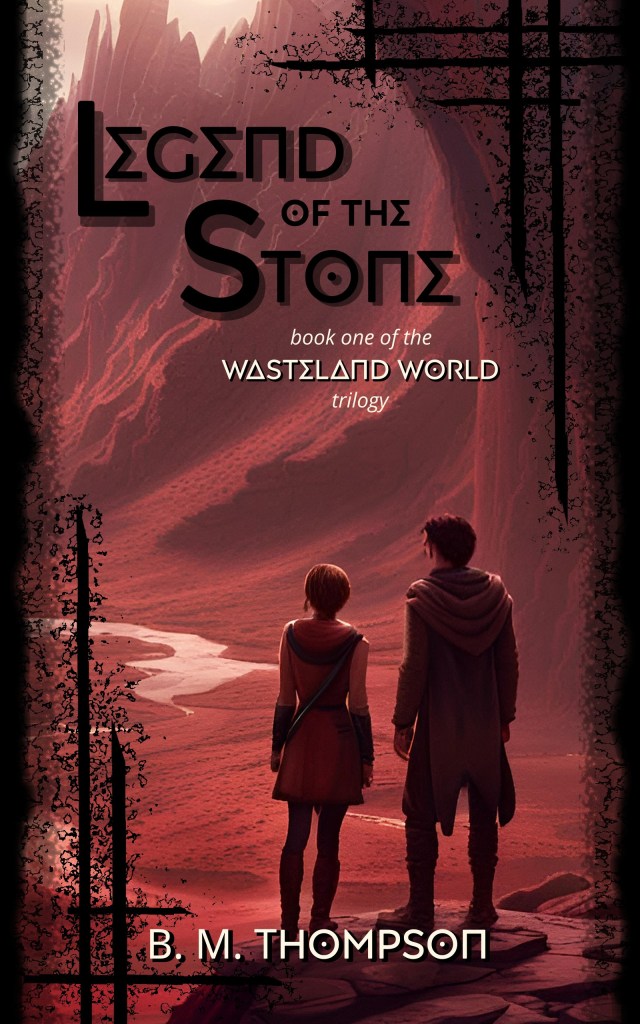
A thousand years ago, the Ruination turned Eleytia to stone. The sky burned red, the waters became toxic, and the animals changed into monsters. The humans unlucky enough to be caught outside the safety of their city walls mutated into the deadly Stone People. They now seek to scour the last of humanity off the face of Eleytia.
Pockets of humanity scratch a meager existence out of the stone Wasteland, unaware of one another and unsure if they are the only humans who survived the cataclysm. In these disparate cities, a young woman is exiled, a defiant soldier deserts a cruel army, and a childless mother vows to save her family.
Stories are told of the mythical—possibly supernatural—Joiners and the amazing feats they once performed. Like the living things that tell them, fables are transformed with age, becoming more confusing and conflicting with each passing year.
Are the Joiners Eleytia’s salvation? Or the curse that caused the Wasteland in the first place?
Did you already read it? If so, Would you take a moment to leave a rating or review? It really helps other readers find my book!
– Amazon –
– StoryGraph –
– Goodreads –
Check out the first chapter below.
“I see a time of darkness coming when your descendants will encounter monsters. They will be horrified to discover it is not the monsters who are evil, but they themselves. They will find that they brought the plague that torments this land. They will leave their homes and families to seek hope and restoration but will return empty-handed. This is my curse upon you.”
— Carnos Mulinus, assassin
Last words spoken before he was hanged
Year 3897 in the Third Era
Fae Turnshaw was exiled on the first holiday she’d ever experienced.
The day had started well: sleeping in, enjoying a break from the fields, watching her father carve a small stone figurine, and talking with her sister and mother. But as night fell, her father’s forehead creased, her mother’s smile disappeared, and her sister’s laughter faded.
After eating dinner—pushing food around on their plates—they joined the funeral march of people trudging through the poorly lit streets toward City Hall. As they walked, Fae breathed in the damp, stuffy air of the Dome, tasting tradition—and terror.
She shivered despite the warm air and stepped closer to her father. Ilya Turnshaw was a bearded, hulking figure, well-muscled from days spent hauling rock in the fields. If he weren’t her father, his huge frame would have loomed ominously in the dark street. But she knew him, knew how he spent his evenings carving lumps of stone into exquisite miniature sculptures, knew his gentle smile and quiet voice.
The gloom lightened as they left the dark streets of Lowtown and entered Hightown, where City Hall was located. Fae’s sister, Sylvie, gasped as the colored light streaming through the stained-glass windows of a nearby mansion bathed her upturned face.
At thirteen years old, Sylvie still viewed the world with wonder in her bright blue eyes. However, Fae knew her joy would dim now that she was working in the fields. The splattering of freckles across Sylvie’s nose had already darkened from the days spent in the sun, and her hands were hardening with the callouses of a Laborer.
In contrast to Sylvie’s awe, Leanne Turnshaw, Fae’s mother, wore a scowl that twisted her delicate features. Leanne’s sightless green eyes couldn’t see the jewel-bright mansions and the dazzling torchlight bleeding from the plentiful street lamps. But her sharp ears could hear that the tense quiet of Lowtown had slunk into the shadows, giving way to the music and laughter that drifted mockingly out of the open windows of the Hightown mansions.
“Disgusting,” she said.
“What’s disgusting?” Sylvie asked.
No one answered her. Now was not the time to discuss why the High Families didn’t consider this night, this holiday, to be one of solemnity, even mourning. However, as they rounded a corner at the end of the street, even Fae couldn’t help but gasp at the grandeur of City Hall.
Streams of golden light flowed out the windows of the colossal building and painted yellow puddles on the courtyard stones. Fae’s eyes rose to the building’s domed roof, a miniature version of the black stone Dome that loomed hundreds of feet above their heads, encasing the entire city of Jorisfell in its protective, stifling embrace. Not for the first time, Fae tried to imagine what it had been like to see the city in the light of day, before the Dome captured it in eternal darkness.
As they drew closer to City Hall, Fae stared at one of the two statues flanking the huge entrance doors—a man wearing a breast plate, gauntlets, and greaves. He held a long spear in his right hand and a massive shield in his left. Although a pointed helmet covered most of his face, Fae could see a pair of stone-cold, expressionless eyes behind the visor.
She glanced at her father to see what he thought of the stonework, but he only had eyes for her mother. He had wrapped his arm about her shoulders and was whispering in her ear, her pale wavy hair obscuring his lips. She had her eyes squeezed shut, but a tear quivered on her cheek, sparkling in the torchlight. Fae felt a small hand slip into hers, and she met her sister’s blue-eyed gaze peering at her from under a wrinkled forehead, a fearful expression that shouldn’t be found on the face of a thirteen-year-old.
“It’s going to be fine,” Fae said in a hearty voice she hoped didn’t betray her own fear.
She squeezed Sylvie’s hand, and they climbed the stone steps into City Hall. After crossing an echoing entrance gallery, they stepped through a second set of doors—these wooden and ornately carved—into a massive audience chamber. Thousands of torches and candles illuminated the room, making Fae’s eyes water as if she had stepped out of the darkness of the Dome into the intense sunlight of the Wasteland. She blinked to clear her vision and saw rows of chairs, split in half by a central aisle, marching toward a raised dais against the far wall. The dais bore a line of thirteen golden throne-like chairs and a velvet-draped podium.
Pale-faced, tight-lipped citizens occupied seats at the middle and back of the auditorium, so the Turnshaws walked toward free seats near the dais. As they moved deeper into the room, Fae began to make out the faces of the people on the dais—Jorisfell’s Councilmen. Their fine silk clothing and gold jewelry shone in the torchlight. Although she was wearing her best dress, which had been mended and altered multiple times as she grew, she felt suddenly self-conscious.
She pulled her eyes away from the well-dressed men to the woman who stood behind the podium, wearing the only smile in the entire chamber. Gertrude Flanery—Madam Flanery, as she demanded to be called—claimed dominion as the Head Teacher in Jorisfell. As usual, she had pulled her dark hair into a severe bun at the nape of her neck and wrapped her ponderous frame in an unremarkable gray dress. Tonight, she lacked the ever-present ruler, which she wielded ruthlessly to encourage obedience from her young charges. Fae had been thankful when she turned twelve five years earlier and left school for the fields. Getting away from Flanery, even to perform hard labor, was an improvement
Fae reached a row with four empty seats and led Sylvie to them. Her father followed, his huge hand clasped around her mother’s arm, acting as her guide in place of her cane. Fae would have liked to see a smile, a nod, anything from him, but his face was a dark mask.
The chamber filled quickly. The Laborers in attendance were pale and silent, while the High Families, who had been celebrating in their mansions, babbled to one another in anticipation. Their voices died when a man rose from one of the gold chairs and strode over to the podium. Like the other Councilmen, his clothing was made of rich silks and covered in expensive embroidery. However, the long, golden chain around his neck and the three long, thin scars stretching across his right cheek from the corner of his nose to his earlobe proclaimed he was Torbin Leigh, Governor of Jorisfell.
“Welcome to the Choosing,” he said in a voice that reverberated through the chamber, amplified by the curved walls. “Tonight, as we have every ten years, we gather to celebrate the anniversary of the first Choosing that took place one-thousand twenty-nine years ago after the Cataclysm nearly destroyed Eleytia. Tonight, we honor the wise rulers of Jorisfell by again appointing several brave souls to follow in the steps of the first Chosen and leave Jorisfell to seek the Joiners, who will bring us salvation from the Wasteland and the monstrous Stone People that roam upon it.”
Fae narrowed her eyes. How could the Governor’s voice sound so bored when he was sentencing children to exile and death? No one could say that, of course, but everyone knew what being Chosen meant.
“Choosing candidates, stand.”
After a moment of hesitation, Fae stood and pulled Sylvie up beside her. Her emerald eyes met her sister’s sapphire ones, and she smiled encouragingly.
“Form a single-file line before the dais.”
The children scooted out of their rows into the central aisle and formed a long line that stretched from the front of the chamber to the double doors at the back.
“The Choosing has begun.”
The first boy stepped forward, so small that Fae had a hard time believing he was twelve, the minimum age of a Choosing candidate. His tense shoulders and clenched fists proclaimed him a heartbeat from bolting out of the room. The row of blank-faced Councilmen stared at him for a few moments before Governor Leigh waved a hand. The boy’s shoulders slumped in relief, and Flanery directed him to cross before the dais and down a side aisle. From there, he ran back of the chamber to where his overjoyed parents waited with open arms.
The Choosing continued, and Fae and Sylvie shuffled closer to the dais. The huge chamber was impressively quiet aside from the shuffle of small feet against the stone floor. As the minutes dragged on and the Governor waved the children away one by one, the Councilmen’s brows furrowed and their fingers drummed against their armrests. Still, no one was Chosen. Fae had once asked Flanery what they looked for in the Choosing candidates.
“The Councilmen, in all their wisdom, can sense the proper boys and girls deserving of that great honor.”
Like every other answer the woman gave, it meant nothing.
When Fae stood third-in-line from the dais, she had drawn close enough to the dais to catch a glimpse of a man in the shadows behind the row of Councilmen. A matted white beard covered the man’s chest, and his shaking hand clutched a knobbed cane. His eyes glittered beneath snarled eyebrows as he stared at the current candidate. After a moment, he shook his head. Leigh waved his hand, and the boy, heaving a sigh of relief, scuttled off down the side aisle. The next candidate stepped forward, and Fae again watched the man in the shadows stare for a few seconds then shake his head. Once more, Leigh waved his hand and the girl escaped.
Then it was Fae’s turn. She was distracted by the man and didn’t step forward immediately, so Flanery seized her arm in an iron grip and yanked her forward. The stares of the Councilmen were intense, especially the Governor’s steely blue-eyed glare, so she looked past them—and into the eyes of the man in the shadows. As their gazes met, she felt as if someone reached out and tugged on her hand. She flinched and glanced around, but she was alone; Flanery stood several feet away and out of reach. Fae looked back up at the dais and saw the man in the shadows nod.
Leigh rose from his chair once more, and this time, instead of causing silence, the motion made whispers spring up throughout the silent chamber.
“May I present to you the first of the Chosen,” he said.
 THE QUILL & THE INKPOT